The global workforce is undergoing a transformation unlike any seen since the Industrial Revolution. The traditional 9-to-5 structure is rapidly giving way to a decentralized, project-based model—the gig economy. For those seeking flexibility, autonomy, and the chance to monetize specialized skills, this shift represents an unparalleled opportunity. However, moving from employee to independent contractor requires more than just a skillset; it demands a strategic approach to business development.
The single most daunting hurdle for any aspiring freelancer, consultant, or gig worker is not completing the work, but finding it. Securing that first client is the critical inflection point that validates your business idea, builds your confidence, and establishes the foundational proof of concept necessary for sustainable growth. This comprehensive guide will explain the mechanics of the modern gig economy and provide a meticulously detailed, step-by-step blueprint for landing your very first paying client.
The Gig Economy Explained: How to Find Your First Client and Launch Your Freelance Career
Part I: Understanding the Modern Work Landscape
Before diving into client acquisition, it is essential to understand the ecosystem in which you will operate. The gig economy is not a monolithic entity; it is a diverse collection of platforms, industries, and specialized services.
What Exactly is the Gig Economy?
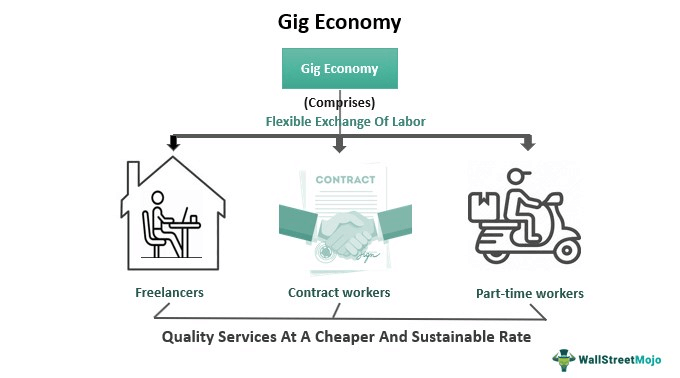
The term “gig economy” describes a free market system in which temporary, short-term contracts or freelance assignments are common, rather than permanent jobs. Workers are independent contractors, not employees. They are hired for specific tasks or projects (the “gigs”) and are paid upon completion.

sumber: wallstreetmojo-files.s3.ap-south-1.amazonaws.com
This model spans far beyond common examples like ride-sharing or food delivery. The high-skill gig economy includes:
- Knowledge Work: Software development, data analysis, specialized consulting, financial modeling.
- Creative Services: Content writing, graphic design, video editing, social media management, UX/UI design.
- Professional Services: Accounting, legal counsel, virtual assistance, specialized project management.
In essence, the modern gig worker is an entrepreneur selling specialized expertise on a project basis.
Why the Shift? Benefits and Challenges
The rapid expansion of the gig economy is driven by technological advancements (making remote collaboration seamless) and evolving business needs (the desire for specialized, on-demand talent without the overhead of full-time employment).
Benefits for the Worker:
- Autonomy: You choose the projects, the hours, and the clients you work with.
- Flexibility: The ability to work from anywhere, tailoring your professional life to your personal schedule.
- Higher Earning Potential: Specialized skills often command higher hourly rates than equivalent salaried positions, provided you manage your pipeline effectively.
Challenges for the Worker:
- Instability: Income can fluctuate wildly, especially in the beginning.
- Administrative Burden: You are responsible for taxes, insurance, benefits, and invoicing.
- Client Acquisition: Finding and retaining clients is a constant, necessary task—a skill set separate from your core expertise.
Expert Insight: Success in the gig economy hinges not just on your primary skill (e.g., coding) but on your secondary skills: marketing, networking, time management, and financial discipline. Treat yourself as a small business from day one.
Part II: Preparing for Launch: Essential Pre-Client Steps
Before you can successfully pitch a client, you must solidify your offering. A vague service offering results in vague client interest. Clarity equals confidence, and confidence closes deals.
Defining Your Niche and Value Proposition
The biggest mistake beginners make is marketing themselves too broadly (e.g., “I am a writer” or “I am a designer”). In a crowded marketplace, specialization is your competitive advantage.
Actionable Step: Define Your Niche By Intersection.
Identify the intersection of your skill, the industry you enjoy, and the specific problem you solve. This creates a powerful value proposition.
- Broad: Social Media Manager.
- Niche: LinkedIn Strategy Consultant for B2B Financial Services Firms.
- Broad: Web Developer.
- Niche: Shopify Migration Specialist for DTC (Direct-to-Consumer) E-commerce Brands under $5 million in revenue.
Your value proposition should clearly state the benefit the client receives, not just the task you perform. Instead of saying, “I write blog posts,” say, “I generate qualified leads by creating SEO-optimized, industry-specific long-form content.”
Pricing Strategy: Knowing Your Worth
Determining your rate is challenging, but critical. Pricing too low signals low value and leads to burnout; pricing too high scares off early clients.
Three Pricing Models:
- Hourly Rate: Best for tasks with unpredictable scope or ongoing consulting. Calculate your desired annual salary, add 30% for overhead (taxes, insurance, downtime), and divide by 1,500 billable hours per year (assuming 2,000 working hours, with 500 spent on marketing/admin).
- Project Rate (Fixed Fee): Best for defined deliverables (e.g., writing a 2,000-word article, designing a logo). This rewards efficiency and expertise.
- Value-Based Pricing: Charging based on the financial outcome for the client (e.g., “I charge 10% of the cost savings my system implementation provides”). This requires significant expertise and is typically reserved for experienced consultants.
For your first client, consider offering a slightly lower, compelling project rate in exchange for a detailed testimonial and permission to use the work in your portfolio. This trades short-term income for long-term credibility.
The Portfolio Imperative: Proving Your Capabilities
Clients hire based on proof, not promises. If you are starting from scratch, you must create proof.
How to Build a Portfolio Without Paid Work:
- Spec Work (Self-Directed Projects): Create a hypothetical project for a real company you admire. If you are a designer, redesign their landing page. If you are a copywriter, write a new email sequence for their product launch.
- Pro Bono/Volunteer Work: Offer your services free or at a steep discount to a non-profit, a small local business, or a friend’s startup. This provides a real client context, deadlines, and a testimonial.
- Case Studies: For every piece in your portfolio, detail the problem, your solution, and the measurable results (even if the results are hypothetical or small).
Your portfolio should be easily accessible (a clean website or professional PDF) and feature only your best, most relevant work to your defined niche.
Part III: The Hunt: Strategies for Finding Your First Client
Finding the first client requires a multi-pronged approach. You must allocate time daily to client acquisition, treating it as seriously as the work itself.
Leveraging Traditional Freelance Platforms
Platforms like Upwork, Fiverr, and Freelancer are excellent places to find your first few projects because they aggregate demand. However, they are highly competitive.
Strategy for Beginners on Platforms:
- Target Smaller Projects: Avoid applying for massive, high-budget contracts initially. Seek out small, defined tasks (e.g., “Review our current SEO setup,” “Write three social media captions”). These projects allow you to build five-star reviews quickly.
- Over-Deliver: On your first three projects, deliver exceptional quality, communicate instantly, and finish early. Positive reviews are currency on these platforms.
- Customize Every Proposal: Never use a template. Reference specific details from the client’s job post and explain exactly how your portfolio piece addresses their need.
Warning: Be prepared to bid slightly lower than average initially to secure the critical first review. Once you have three or four positive reviews, you can raise your rates significantly.
The Power of Your Professional Network (The Warm Market)
Your first client is often someone you already know or someone connected to them. People are far more likely to hire someone recommended by a trusted contact than a stranger online.
How to Tap Your Warm Market:
- The Informational Announcement: Do not ask for a job. Announce your new venture professionally. Send personalized emails or LinkedIn messages to former colleagues, managers, and professional contacts. State clearly what you now do and the specific type of client you are looking for.
Example: “Hi [Name], I recently launched my consulting business specializing in helping small businesses streamline their email marketing automation. If you know anyone struggling with lead nurturing, I’d appreciate an introduction.”
- The Soft Ask: Offer a free 30-minute consultation to your network contacts. This is low commitment for them but allows you to demonstrate expertise and identify potential problems you can solve.
- Update Your Digital Presence: Ensure your LinkedIn profile, social media bios, and personal website clearly reflect your new status as an independent consultant and list your specific services.
Cold Outreach and Personalized Pitching
Cold outreach involves identifying companies or individuals who need your service and contacting them directly. This is the most professional and scalable long-term method.
The Research-First Approach:
- Identify Pain Points: Use tools like SEMrush, Google PageSpeed Insights, or simply manually audit a company’s website or content. Look for measurable deficiencies (e.g., slow loading speed, broken links, outdated case studies, poor SEO ranking).
- Target the Decision Maker: Find the appropriate person (usually a CEO, Marketing Director, or Head of HR) via LinkedIn or corporate directories.
- The Value-Driven Pitch: Your pitch must be short and focused entirely on the client’s existing problem and the direct financial benefit of solving it.
Sample Cold Pitch Structure:
- Hook (1 sentence): Acknowledge a recent company achievement or news item to prove you did your homework.
- The Observation (1–2 sentences): State the specific pain point you found during your audit (e.g., “I noticed your blog traffic has been flat over the last quarter, likely due to low keyword density on your service pages.”)
- The Solution/Proof (2 sentences): Offer a brief, specific solution and cite a similar result from your portfolio (e.g., “I specialize in optimizing content for the [Industry] niche and helped Company X increase their organic traffic by 40% in six months.”)
- The Call to Action (1 sentence): Request a brief, low-commitment meeting (e.g., “Would you be open to a 15-minute call next week to discuss this further?”)
Niche Job Boards and Specialized Communities
While the large platforms are crowded, many specialized industries have their own job boards or communities where high-quality clients post opportunities.
- Examples: If you are a Python developer, check GitHub job boards. If you are a medical writer, look for opportunities within professional medical associations.
- Community Engagement: Join relevant professional Slack channels, Reddit groups, or industry forums. Do not spam your services. Instead, answer questions, provide genuine value, and demonstrate your expertise. Leads will naturally flow to the expert who consistently helps others.
Part IV: Mastering the Pitch and Conversion
Once you have a lead, the goal is to convert them into a paying client. This transition requires professionalism, clear communication, and a focus on solving the client’s fundamental problems.
Crafting the Irresistible Proposal
A successful proposal is not just a price list; it’s a tailored business case that justifies your fee by detailing the return on investment (ROI).
Key Components of a Client-Winning Proposal:
- Understanding the Problem: Start by summarizing the client’s challenge in their own words. This shows you listened and empathized.
- Proposed Solution and Scope: Detail the specific actions you will take (e.g., “Phase 1: Keyword Research and Competitor Analysis,” “Phase 2: Content Outline Creation”). Define what is included and, critically, what is not included.
- Deliverables and Timeline: Clearly list what the client receives (e.g., 5 blog posts, 1 design mock-up) and when they will receive it.
- Pricing and Payment Terms: Clearly state the fixed project fee or the hourly rate, along with required upfront deposits (common practice is 50% upfront for new clients).
- Next Steps: Make it easy for them to say yes (e.g., “To move forward, simply sign below and remit the 50% deposit.”)
The Importance of Follow-Up
Persistence is often the difference between securing the first client and failing. Decision-makers are busy, and your proposal may simply have been buried.
- Follow-Up Schedule: If you don’t hear back after sending a proposal, wait 3–4 business days, and send a polite, brief email checking in.
- The Value-Add Follow-Up: If you still don’t hear back, wait another week and send an email with a new piece of relevant information (e.g., “I saw this article about your competitor, and it reminded me of the strategy we discussed. Here are three quick ideas…”). This keeps you top-of-mind without sounding desperate.
Setting Expectations and Onboarding
The moment the contract is signed and payment is received, the relationship shifts from sales to execution. Professional onboarding is crucial for a smooth project and a positive first impression.
- The Kick-off Meeting: Schedule a brief meeting to review the scope of work, introduce your communication tools (Slack, email, project management software), and define the expected feedback loop.
- Boundaries: Clearly state your working hours and expected response times. This prevents scope creep and protects your personal time.
- Documentation: Maintain detailed documentation of all conversations, changes in scope, and decisions made. This protects both you and the client.
Conclusion: The First Client is Just the Beginning
Securing your first client in the gig economy is a monumental achievement. It proves that your skills are valuable, your approach is sound, and your entrepreneurial spirit is resilient. This first project is not just about the money; it is about establishing a track record, gathering a testimonial, and refining your delivery process.
The gig economy demands that you be both the expert service provider and the chief marketing officer of your own business. By clearly defining your niche, building undeniable proof of your capabilities, and executing a targeted client acquisition strategy, you move beyond aspiring freelancer to established professional. The confidence gained from that first successful project will fuel the momentum needed to build a sustainable, lucrative, and flexible career on your own terms.
sumber : Youtube.com